Top 10 NEC Violations in 2026: Avoid the Red Tag

Written By
The Zing2 Engineering Team
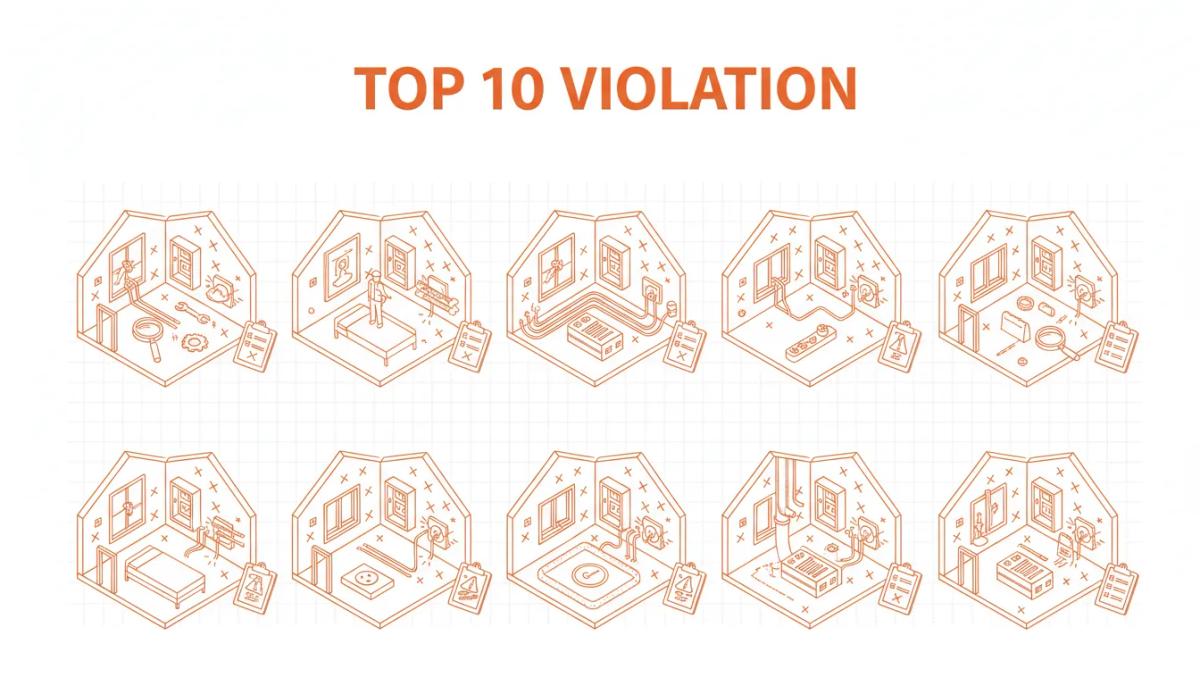
The Brutal Cost of Inspection Failure
Time is money. A red tag is a deficit. In the high-stakes environment of 2026 electrical contracting, compliance is not a suggestion—it is the baseline for profitability. An inspection failure stops production, delays draws, and erodes professional reputation.
We analyze the critical compliance gaps for 2026. Local AHJ (Authority Having Jurisdiction) requirements may vary; always verify local amendments before final installation.
1. Grounding and Bonding Failures (NEC 250.50)
**Why it's Frequent:** Improper electrode selection or incomplete bonding paths. Often, installers fail to bond all available electrodes at a structure, specifically neglecting concrete-encased electrodes (Ufer grounds) in new construction.
**How to Fix It:** Verify continuous bonding to all required electrodes. Ensure the grounding electrode system is interconnected to create a permanent, low-impedance path.
"All grounding electrodes as described in 250.52(A)(1) through (A)(7) that are present at each building or structure served shall be bonded together to form the grounding electrode system."
**Zing2 Solution:** Reference our [NEC Tables Guide](/blog/stop-flipping-pages-how-to-find-nec-2020-codes-in-seconds) for grounding electrode conductor (GEC) sizing based on the largest ungrounded conductor.
2. Working Space and Clearance Infractions (NEC 110.26)
**Why it's Frequent:** Staging materials, HVAC ductwork, or permanent plumbing structures encroaching on electrical equipment.
**How to Fix It:** Maintain a clear zone: 30 inches wide (or the width of the equipment) by 36 inches deep. This space must extend from the floor to a height of 6.5 feet or the height of the equipment.
[NEC 110.26(A)(1): The depth of the working space in the direction of live parts operating at 600 volts, nominal, or less to ground and likely to require examination, adjustment, servicing, or maintenance while energized shall not be less than specified in Table 110.26(A)(1).]
**Zing2 Solution:** Use the methodology outlined in our "Stop Flipping Pages" guide to verify specific clearance for higher voltages where 36 inches may be insufficient.
3. Box Fill and Raceway Overcrowding (NEC 314.16)
**Why it's Frequent:** Retrofitting more circuits than volume allows. Installers often underestimate the volume displacement of large-gauge conductors, internal clamps, and support fittings.
**How to Fix It:** Adhere strictly to volume allowances per conductor size.
**Zing2 Solution:** Consult our [Box Fill Calculator](/tools/box-fill-calculator) for instant volume verification before pushing wire.
4. GFCI Protection Gaps (NEC 210.8)
**Why it's Frequent:** Misinterpreting expanded requirements for outdoor outlets and high-voltage residential circuits (e.g., HVAC units and dryers). 2026 standards have tightened requirements for hard-wired appliances.
**How to Fix It:** Standardize GFCI protection for all required outlets regardless of proximity to sinks if they fall within the expanded categories of NEC 210.8.
**Zing2 Solution:** Check the Pro Tips category on ZING2 to track AHJ-specific GFCI variances in major hubs like Dallas and New York.
5. AFCI Protection Omissions (NEC 210.12)
**Why it's Frequent:** Failure to provide Arc-Fault Circuit-Interrupter protection during panel upgrades or circuit extensions in residential dwellings.
**How to Fix It:** Ensure all 120-volt, single-phase, 15- and 20-ampere branch circuits supplying outlets or devices in kitchens, family rooms, dining rooms, living rooms, and bedrooms are AFCI protected.
6. Conductor Derating and Ampacity Miscalculations (NEC 310.15)
**Why it's Frequent:** Ignoring ambient temperature adjustments and raceway bundling penalties. Running more than three current-carrying conductors in a single raceway without adjusting ampacity is a primary cause of thermal failure and red tags.
**How to Fix It:** Apply Table 310.15(C)(1) (formerly 310.15(B)(3)(a)) adjustment factors before installation.
**Zing2 Solution:** Use our [Wire Size Calculator](/tools/wire-size-calculator) to get corrected ampacity results based on 2026 temperature and bundling variables.
7. Circuit Identification and Labeling (NEC 408.4)
**Why it's Frequent:** Handwritten, vague, or missing panel directories. Labels like "Lights" or "Plugs" are no longer sufficient for compliance.
**How to Fix It:** Every circuit must be "distinguishable" and labeled with its specific purpose. Use printed, permanent labels.
[NEC 408.4(A): Every circuit and circuit modification shall be legibly identified as to its clear, evident, and specific purpose or use. The identification shall include sufficient detail to allow each circuit to be distinguished from all others.]
8. Torque Requirements (NEC 110.14(D))
**Why it's Frequent:** Relying on "hand-tight" feel rather than calibrated instruments.
**How to Fix It:** Where a tightening torque is indicated on the equipment, a calibrated torque tool must be used. Failure to document torque settings often results in rejected service inspections.
9. Improper Securing and Supporting (NEC 300.11)
**Why it's Frequent:** Utilizing non-electrical components (plumbing pipes, ceiling grid wires) to support raceways or cables.
**How to Fix It:** Raceways and cables must be supported by independent means. Use dedicated support wires or clips rated for the specific wiring method (e.g., NEC 334.30 for NM cable; NEC 344.30 for RMC).
10. Abandoned Cable Hazards (NEC 800.25)
**Why it's Frequent:** Leaving old communications or signaling wire in plenums and risers during tenant improvements.
**How to Fix It:** Remove the accessible portion of abandoned cables. Failure to manage "fuel load" in plenum spaces is a common fire marshal red tag that electrical inspectors are now strictly enforcing.
"The accessible portion of abandoned communications cables shall be removed. Abandoned communications cable is as defined in 800.2."
***
FAQ
**What is the most common NEC violation?**
Grounding and bonding (NEC 250) remains the most frequent violation due to its complexity and the critical nature of the low-impedance path.
**Can an AHJ override the NEC?**
Yes. Local jurisdictions can adopt specific versions of the NEC or add local amendments that are more or less restrictive than the national code.
**Is a torque wrench required by the NEC?**
Yes, under NEC 110.14(D), if the manufacturer provides a torque value, the installer must use a calibrated tool to achieve that value.